
About Bird Bonito
Bird Bonito was born from a deep connection with the region’s ecosystems. Before becoming a company, it was admiration. Before becoming an itinerary, it was wonder.
The decision to turn this feeling into work came from the conviction that the region’s natural riches, often unnoticed by those who pass by in haste, deserved to be revealed to the world with care, knowledge and respect.
Birds are the great treasure of this landscape. They connect rivers, forests, grasslands and the invisible boundaries between biomes. They are indicators of environmental health, protagonists of colour and sound, and natural guides to understanding the complexity of ecosystems. Bird Bonito exists as a link between the visitor and this living nature, interpreting environments, behaviours and stories that unfold at every dawn.
Each itinerary is designed on a solid technical foundation, yet conducted with sensitivity. The aim is not merely to list species, but to provide meaningful encounters — those moments when the observer realises they are witnessing something rare, integrated and greater than the sum of its parts.
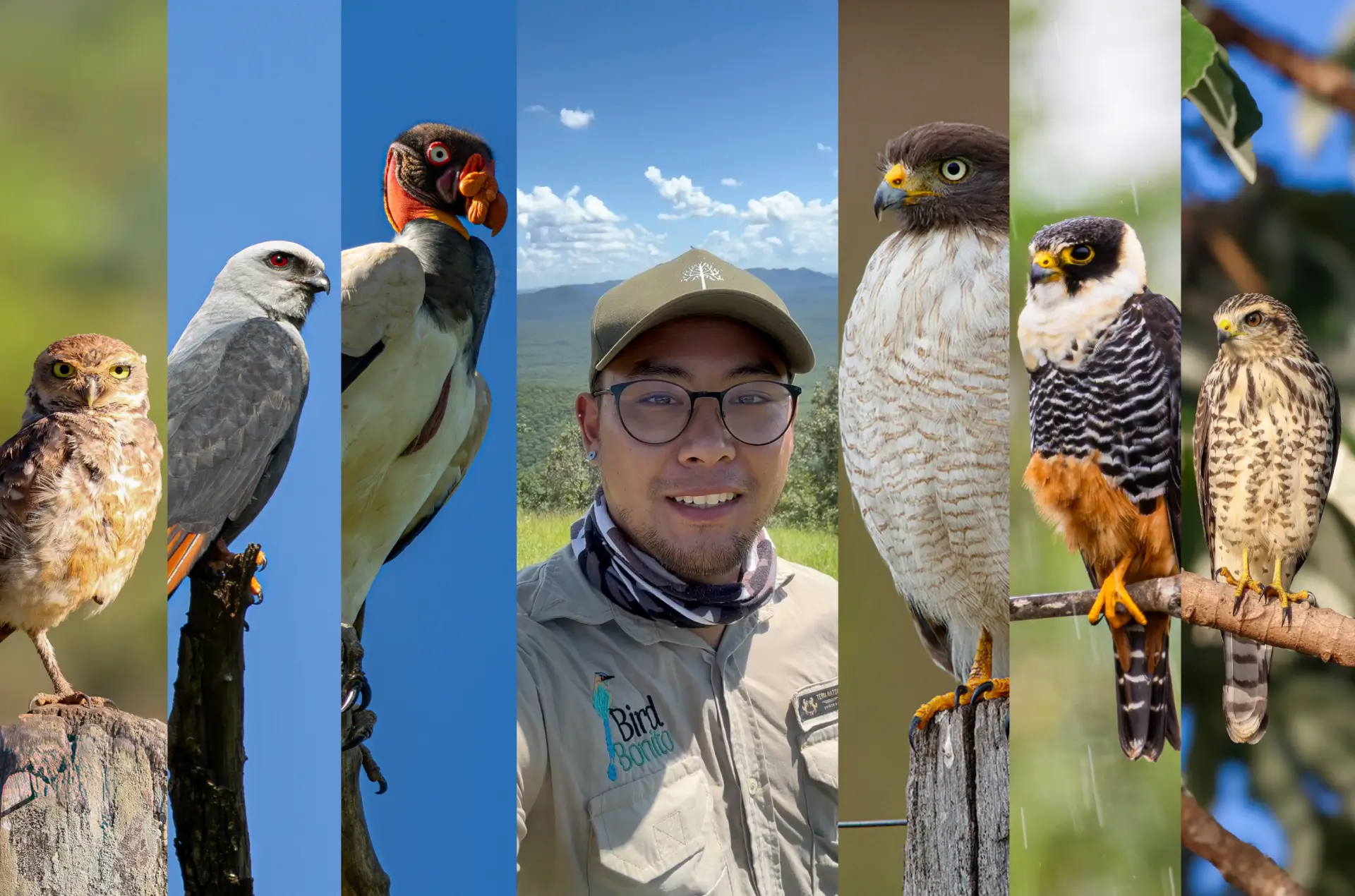
The Guide, Lucas Yanai
Leading the activities is a biologist and professional tour guide who has transformed vocation into mission. Academic training provides the scientific foundation, while constant field experience has shaped a refined reading of the landscape. Species identification, understanding seasonality, recognising vocalisations and interpreting habitats are all part of the guiding process, but what truly sustains the work is a genuine commitment to conservation and to the visitor’s experience.
Guiding is, above all, about mediating encounters. It is knowing when to explain and when to remain silent so that the forest can speak for itself. It is understanding that birdwatching tourism, when well conducted, generates appreciation, a sense of belonging and conservation.
Bird Bonito believes that knowledge leads to respect, and that respect is the first step towards conservation. Every visitor who leaves carrying the memory of a macaw’s flight, the call of a seriema or the reflection of a bird over a crystal-clear river also becomes part of this network of care.
Here, nature and tourism walk side by side. With responsibility. With knowledge. And, above all, with care.
With small groups and tailor-made planning, Bird Bonito combines technical knowledge, teaching, and safety.
eBird ranking · Bonito (MS)
The top-ranked birder in Bonito, Brazil
- overall
- 1st
- checklists submitted
- 706
- species in Bonito
- 226
- species in Mato Grosso do Sul (life list)
- 376
Lucas Yanai leads the eBirder ranking for Bonito (Mato Grosso do Sul, Brazil) on eBird, the world’s largest bird database, run by the Cornell Lab of Ornithology. Every checklist is a public, reviewed and verifiable record. Over the years that fieldwork has spread across the whole state, adding up to hundreds of species across its different biomes.
Bonito figures are for 2026; the Mato Grosso do Sul total is cumulative. Last checked in August 2026.
Our Philosophy
Birding with purpose
Birds are more than just ticks on a list. Each species reveals ecological connections, surprising behaviours and natural histories that enrich the experience in ways no guidebook can match.
The right pace
No rushing. We interpret the environment at nature's own rhythm, pausing to observe behaviour, listen to calls, and maximise every sighting opportunity.
Conservation
Field ethics and minimal impact. We follow strict protocols to avoid disturbing wildlife and actively contribute to the preservation of the habitats we visit.
Differentials
Technical knowledge and expert teaching. Every outing combines precise identification, ecological context and an accessible educational approach for all experience levels.
Guiding in EN · ES · PT · Interpreter EN ⇄ PTBonito · Pantanal · Brazilian ChacoRegistered company · Adventure insurance
Bilingual guide-interpreter in Bonito
Beyond the birding itineraries, Lucas Yanai also works as a bilingual guide-interpreter in Bonito, Brazil, in the English ⇄ Portuguese pair. A biologist and Cadastur-certified guide, he accompanies and leads individuals or groups through the region’s attractions — interpreting what you are seeing, not only what is being said.
English-speaking visitors on tours
Attractions around Bonito are run in Portuguese: the safety briefing, the local monitors’ instructions, the rules of each cave, spring or float trip. I travel with the group and translate it into English as it happens — and in between stops the conversation carries on: bird behaviour, river and forest ecology, why the water is so clear. You stop watching the tour from the outside and start understanding it.
Inbound agencies and tour operators
Agencies, hotels and operators receiving English-speaking groups can book the service by the day or by itinerary, through a registered Brazilian company (CNPJ and Cadastur) with adventure insurance. Eighteen years in the field here mean the attractions, driving distances, seasons and the protocol of each outing are already known — less improvisation for your operation.
This is nature interpretation in the field, English ⇄ Portuguese: accompanying and leading people or groups during the region’s tours and itineraries. Lucas also guides itineraries in Spanish, but interpreting is not offered in that language. It does not include simultaneous interpreting for stages, conferences or events.
Check availabilityExperience and Safety
- Cadastur certified guide (Brazilian Ministry of Tourism)
- Biologist & MSc in Natural Sciences
- 18+ years of field experience
- English, Portuguese, and Spanish
- Adventure insurance included
- Expert in bird behaviour & ecology