
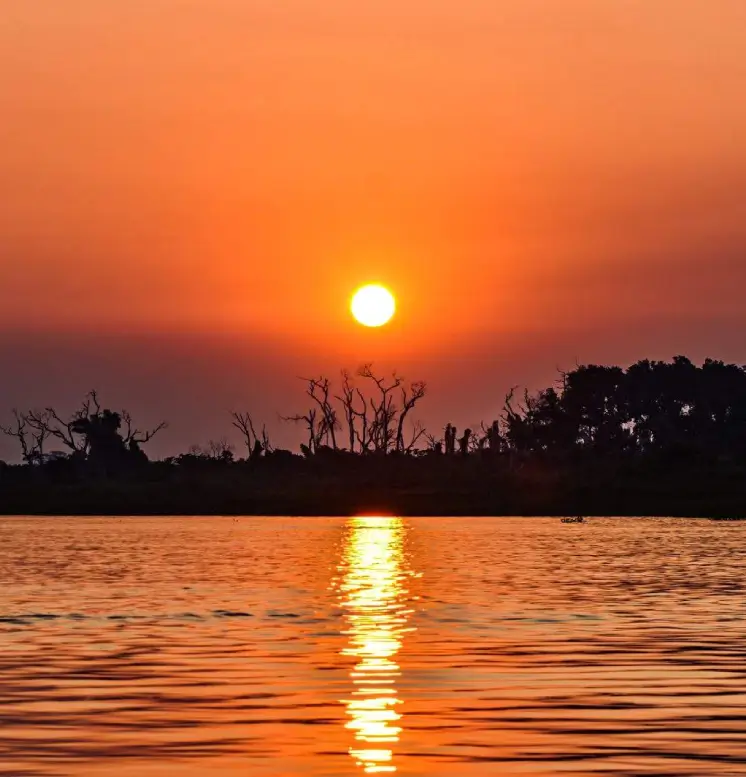
Imagine waking up to the sound of hundreds of birds, with macaws crossing a sky that changes colour by the minute. In the Pantanal, this isn't the exception — it's the routine. Here's everything you need to know to plan your expedition.
Why the Pantanal is special
The Pantanal is the world's largest continental wetland, spanning over 150,000 km². This vastness, combined with an annual flood-and-dry cycle, creates an extremely dynamic ecosystem that supports one of the highest wildlife concentrations in South America.
For birdwatchers, the real advantage is not just diversity — it is visibility. Over 580 species have been recorded here, including iconic birds such as the (the Pantanal's symbol bird), the and the . Unlike closed rainforest, where most species are heard and rarely seen, the Pantanal is open country: herons, storks, spoonbills and raptors sit exposed over flooded grassland and riverbanks, often only metres away.
Southern or northern Pantanal? The choice that shapes your trip
This is the single most useful thing to understand before booking, and most itineraries never explain it. The Pantanal spans two Brazilian states, and the two halves are reached in completely different ways.
The northern Pantanal sits in Mato Grosso. You fly into Cuiabá (CGB) and drive the Transpantaneira road toward Porto Jofre. This is jaguar country — the northern Pantanal is where the reliable jaguar boat safaris operate, from roughly June to October, and it is where almost every international operator goes.
The southern Pantanal sits in Mato Grosso do Sul. You fly into Campo Grande (CGR) or Bonito (BYO) and enter along the Estrada do Parque. The birdlife is largely the same, but there are far fewer visitors, and — crucially — you can combine the wetland with the Cerrado savannah around Bonito and the Brazilian Chaco in a single trip, without extra domestic flights.
Being honest about the trade-off: if photographing a jaguar is your overriding goal, go north. If your priority is birds, an unhurried pace and three biomes in one journey, the south gives you more. Our Southern Pantanal birdwatching tours work the second option.
Best time to visit
The dry season (July to October) is the most recommended period. As rivers recede, fish and other organisms become concentrated in pools and channels, attracting large flocks of waterbirds, herons, spoonbills and raptors. Thinner vegetation makes spotting much easier, and the roads into the wetland stay firm and predictable.
The wet season (November to March) brings migratory species from North America and southern Argentina, and is the breeding season for many resident species. The landscape is spectacular, but the water spreads out and the birds spread with it, so the predictable concentrations disappear.
April to June is an underrated transition: water is already dropping, concentrations are building, and there are fewer visitors than at the peak. For a month-by-month breakdown across all of Brazil, see our guide to the best time to visit Brazil for birdwatching.
Must-see species
(Anodorhynchus hyacinthinus) — The world's largest macaw, with vibrant cobalt-blue plumage and a powerful beak. The Pantanal holds the largest wild population of this species.
(Jabiru mycteria) — The Pantanal's symbol bird, standing up to 1.60m tall. Their large nests are easily visible atop dead trees.
(Cercomacra melanaria) — A Pantanal specialty with a striking call, skulking in the riverside scrub. One of the most sought-after species by listers visiting the region.
Roseate Spoonbill (Platalea ajaja) — Vivid pink plumage and characteristic sweeping feeding behaviour with its spoon-shaped bill.
For a longer list with photographs and field notes, read 15 top birds of the Pantanal you will want to see.
What a day in the field actually looks like
Expeditions in the southern Pantanal combine short trail walks, slow drives along the Estrada do Parque and boat outings on rivers and channels. The day is shaped by bird activity, not by a schedule.
You leave before dawn, because the two or three hours after sunrise produce most of the day's records. Activity collapses in the midday heat — that is the time to rest, review the day list and settle uncertain identifications — then returns in the late afternoon and runs to dusk, which is the best window for waterbirds gathering in the bays and macaws returning to roost. On multi-day trips a short night outing adds owls and nightjars.
Mammals and other wildlife
Birdwatching in the Pantanal is inevitably also a wildlife safari. Capybaras, caimans, armadillos, giant anteaters, southern tamanduas, capuchin monkeys, crab-eating foxes, marsh deer and tapirs are all part of the region's fauna, and with luck the elusive maned wolf may appear.
Jaguars do occur in the southern Pantanal, but sightings are uncommon and are not what these tours are built around — the dependable jaguar viewing is at Porto Jofre in the north. We would rather set that expectation clearly than have you arrive hoping for something the region does not reliably deliver.
Getting there
Campo Grande (CGR) is the practical international gateway, with the widest choice of connections; from there it is roughly a four-hour drive to Bonito. Bonito's own airport (BYO) takes direct flights from São Paulo (GRU) and Campo Grande, and sits 15 minutes from town. Full details, including visas and transfers, are in our guide on how to get to Bonito and the Pantanal.
Want to see these species up close? Explore our Southern Pantanal birdwatching and wildlife tours, or request a personalised quote.