

Pantanal Birdwatching Tours: Southern Pantanal Birding & Wildlife Safaris
Southern Pantanal Birdwatching & Wildlife Tours (via Campo Grande)
Private 1–4 day birding and wildlife expeditions in the Southern Pantanal, entering via the Estrada do Parque from Bonito and the Campo Grande (CGR) gateway, led by biologist and guide Lucas Yanai.
The Southern Pantanal is shaped by the rhythm of its waters. The annual flood and dry cycle completely transforms the landscape, shifting between open plains and vast wetlands, creating one of the most dynamic and productive ecosystems on the planet.
We reach the Southern Pantanal from Bonito and the Campo Grande (CGR) gateway along the Estrada do Parque — the southern route into the wetland, distinct from the northern Cuiabá/Transpantaneira access most operators use. It is the practical, well-connected way in for international birders.
This natural pulse enhances birdwatching in the Southern Pantanal, especially during the receding waters, when food becomes concentrated and emblematic and migratory species gather in key areas. Each season reveals different behaviours and bird assemblages.
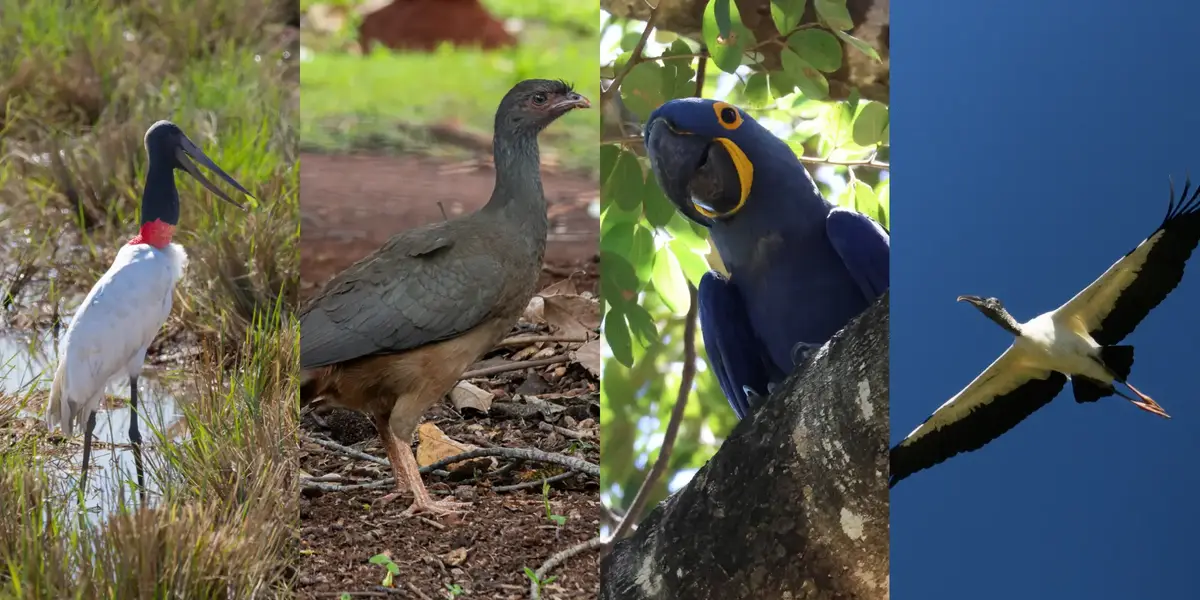
The experience becomes a genuine wildlife safari: alongside birds such as the and , mammals move with the waters. Capybaras, armadillos, giant anteaters, southern tamanduas, capuchin monkeys, crab-eating foxes, marsh deer and tapirs are all part of the region's fauna, and with luck the elusive maned wolf may appear.
As access, climate and wildlife concentration vary seasonally, consulting a specialised guide is essential to select the best period and maximise sightings. In the Pantanal, everything responds to water — understanding this cycle is key to experiencing the region at its fullest.
Headline species
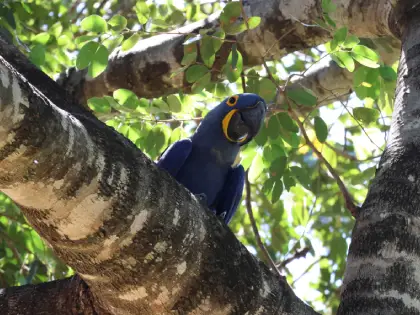
Hyacinth Macaw
Anodorhynchus hyacinthinus
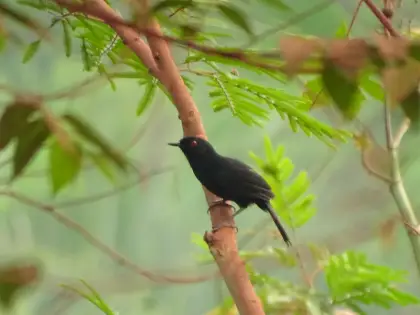
Mato Grosso Antbird
Cercomacra melanaria
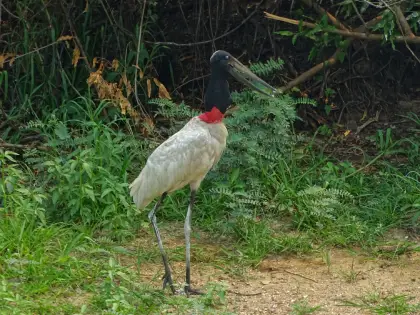
Jabiru
Jabiru mycteria
Pantanal birding tour at a glance
- Region
- Southern Pantanal, Mato Grosso do Sul, Brazil
- Access
- Estrada do Parque, from Bonito or Campo Grande (CGR)
- Duration
- 1 to 4 days
- Best season
- Dry season, July to October
- Format
- Private and tailor-made — dates, pace and target species set with you
- Guide
- Lucas Yanai, biologist, Cadastur-certified, 18+ years in the field
- Languages
- English, Portuguese and Spanish
- Level
- Intermediate trail — short walks on flat terrain
Why the Southern Pantanal is some of the best birdwatching in the Pantanal
The Pantanal is the largest continental wetland on the planet, and its advantage for birdwatchers is not only diversity — it is visibility. Unlike closed forest, where most species are heard and seldom seen, the landscape here is open. Herons, storks, spoonbills and raptors sit exposed over flooded grassland, shallow bays and riverbanks, often just metres from the road.
Everything is organised by water. The annual flood-and-recede cycle completely redraws the landscape, and the birdlife responds to it with precision. As the waters drop, water that was spread across kilometres shrinks into shallow bays and pools, concentrating fish, amphibians and invertebrates — and concentrating the birds that feed on them along with it. That is why the dry season is so productive: there are not more birds, they are predictably gathered.
Our expeditions work the Southern Pantanal, in Mato Grosso do Sul, entering along the Estrada do Parque from Bonito or from Campo Grande (CGR). It is a region of open grassland, wooded ridges, seasonal channels and the banks of the Miranda and Aquidauana rivers — a mosaic of habitats that delivers very different bird families within a few kilometres.
Birdwatching in the Pantanal is also, unavoidably, a wildlife safari. Capybaras, armadillos, giant anteaters, southern tamanduas, capuchin monkeys, crab-eating foxes, marsh deer and tapirs are all part of the region's fauna, and with luck the elusive maned wolf may appear. For visitors from the United States or Europe, that combination of birds and large mammals in a single day afield is what makes the Pantanal hard to compare with anywhere else.
Southern vs Northern Pantanal: which one for birdwatching?
Almost every international operator sells the Northern Pantanal — Cuiabá, the Transpantaneira, Porto Jofre. We work the South. The two halves share most of their birdlife, but the logistics and the expectations are different, and it is worth understanding that before you book.
| Southern Pantanal (our tours) | Northern Pantanal | |
|---|---|---|
| State | Mato Grosso do Sul (MS) | Mato Grosso (MT) |
| Gateway airport | Campo Grande (CGR), or Bonito (BYO) | Cuiabá (CGB) |
| Main access road | Estrada do Parque | Transpantaneira |
| Jaguars | Not the focus. Sightings are possible but uncommon — we do not promise jaguars. | The region's speciality, above all at Porto Jofre, June to October. |
| Crowds | Considerably lower — it is common to spend a day without meeting another group. | High in jaguar season, with competition for boats and lodges. |
| Combines well with | Bonito and the Cerrado, Buraco das Araras and the Brazilian Chaco — three biomes in one trip. | Chapada dos Guimarães and the southern Amazon (Alta Floresta). |
To be direct: if photographing a jaguar is your single overriding priority, the Northern Pantanal is the place, and we will tell you so. If your priority is birds, an unhurried pace, a biologist guide and the option of adding the Cerrado and the Chaco to the same trip, the Southern Pantanal gives you more.
How a day of birdwatching in the Pantanal works
Tours of 1 to 4 days are built to order, so the exact route depends on your dates, the water level and your target species. The shape of the day, however, follows bird activity — and it is always this:
Before dawn: departure and transfer
We leave in the dark so we are in the field when activity starts. That is the real cost of a good day of Pantanal birding, and it is also when owls and nightjars are still active.
First hours: the morning peak
The two or three hours after sunrise account for most of the day's records. We work slowly, in short stretches, stopping often: this is when Hyacinth Macaws pass overhead, Jabirus stand at their nests, raptors warm up and the Mato Grosso Antbird calls from the riverbank scrub.
Midday: the lull
Heat shuts bird activity down, and pushing through it yields little. This is the time to rest, review the day list, settle uncertain identifications and deal with photographs — and, in the Pantanal, to watch mammals and caiman, which stay visible.
Late afternoon: the second peak
Activity returns as the temperature drops and runs to dusk. It is the best window for waterbirds gathering in the bays, macaw flights returning to roost, and the light nature photographers are after.
After dark: optional night outing
On multi-day itineraries a short night outing is worth it for owls, nightjars and nocturnal mammals. It is optional and depends on your pace — field days in the Pantanal start very early.
Best time for birdwatching in the Pantanal
The Pantanal does not have a high and low season for birds — it has two completely different water regimes, each with its own advantages.
Dry season, July to October — the best window
This is the period we recommend and when we concentrate our expeditions. Receding water concentrates birds and wildlife around what is left, roads are firm and access is predictable. July and August are dry with cool nights; September and October are hotter, with intense breeding activity. If you can choose your dates, choose here.
Wet season, November to March — green, full and harder
The landscape turns lush, migratory species arrive and song activity is high. In exchange, the water spreads out and so do the birds: the predictable concentration disappears, and stretches of road can become impassable. It is an interesting season for someone who already knows the Pantanal or is after breeding behaviour, not for a first visit.
April to June — the transition
Water starts to drop and bird concentration builds progressively, with fewer visitors than the July–October peak. It is a good and frequently underrated window, especially if your dates are flexible.
Flagship birds of the Southern Pantanal
Hyacinth Macaw
Anodorhynchus hyacinthinus
The world's largest macaw, with cobalt-blue plumage and a powerful bill. The Pantanal holds the largest wild population of the species, and it is one of the more reliable targets here in the dry season.
Jabiru
Jabiru mycteria
The symbol bird of the Pantanal and of Mato Grosso do Sul, standing up to 1.60 m tall. Its large nests, built atop dead trees, are visible from a distance.
Mato Grosso Antbird
Cercomacra melanaria
Notable vocalisations and a bird that is difficult to photograph, staying among branches and leaves along Pantanal riverbanks — traits that drive birdwatchers to seek the best possible record.
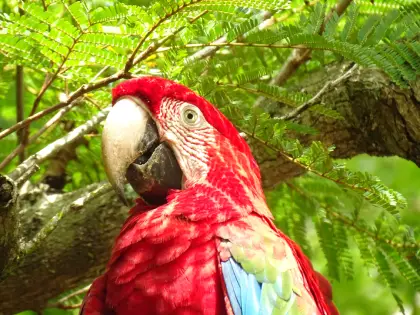
Red-and-green Macaw
Ara chloropterus
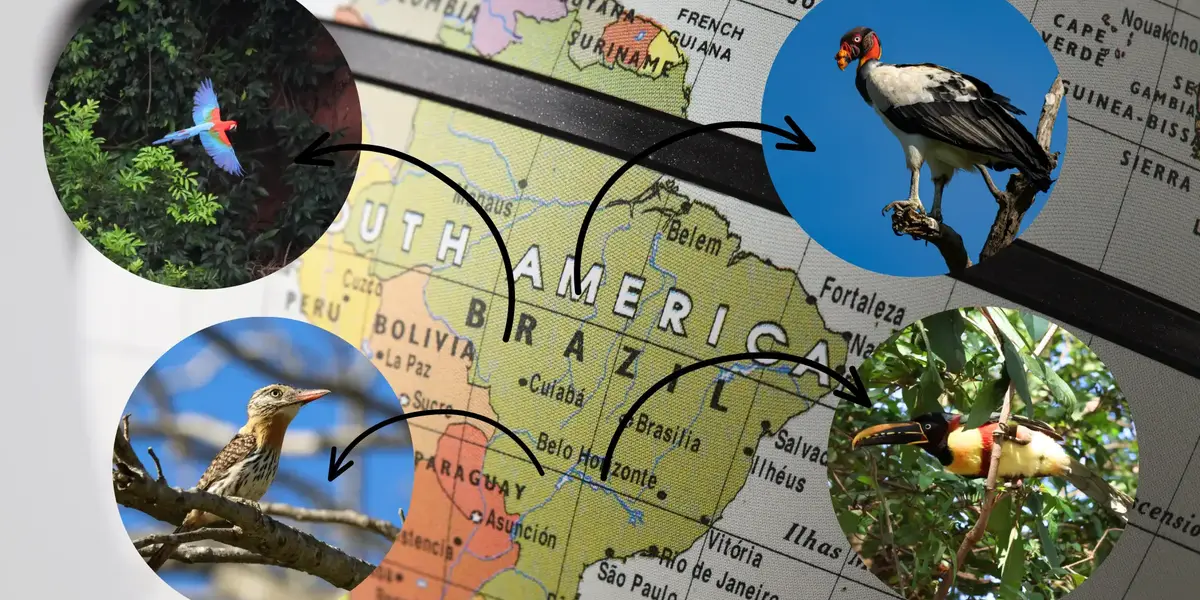
The second largest macaw found in the region. It can be seen in pairs or in large flocks of dozens of individuals.
What is included
- Cadastur-certified biologist guide (Lucas Yanai) throughout the expedition, in English, Portuguese or Spanish.
- Itinerary planning around your dates, pace, experience level and target species list.
- Field identification support and a list of species recorded by the end of the tour.
- Adventure insurance, included in all tours.
- Free cancellation up to 30 days before the tour date, and free rescheduling in case of adverse weather.
- Airport transfer and transport logistics arranged, once you share your flight details.
Practical information for reaching the Southern Pantanal
- Campo Grande (CGR) is the most practical international airport, with the widest choice of connections; from there it is about a 4-hour drive to Bonito.
- Bonito (BYO) receives direct flights from São Paulo (GRU) and Campo Grande (CGR), and is 15 minutes from town.
- Citizens of the EU, USA, UK, Canada, Australia and Japan do not need a visa for stays of up to 90 days in Brazil.
- Bring your own binoculars, sunscreen, insect repellent, a hat and long sleeves in neutral colours. A scope is useful for open grassland and bays, but not essential.
Species you may encounter on this Pantanal birdwatching tour
- Arapapá
Boat-billed Heron
Cochlearius cochlearius - Arara-azul
Hyacinth Macaw
Anodorhynchus hyacinthinus - Arara-canindé
Blue-and-yellow Macaw
Ara ararauna - Arara-vermelha
Red-and-green Macaw
Ara chloropterus - Periquito-rei
Peach-fronted Parakeet
Eupsittula aurea - Biguá
Neotropic Cormorant
Nannopterum brasilianum - Cabeça-seca
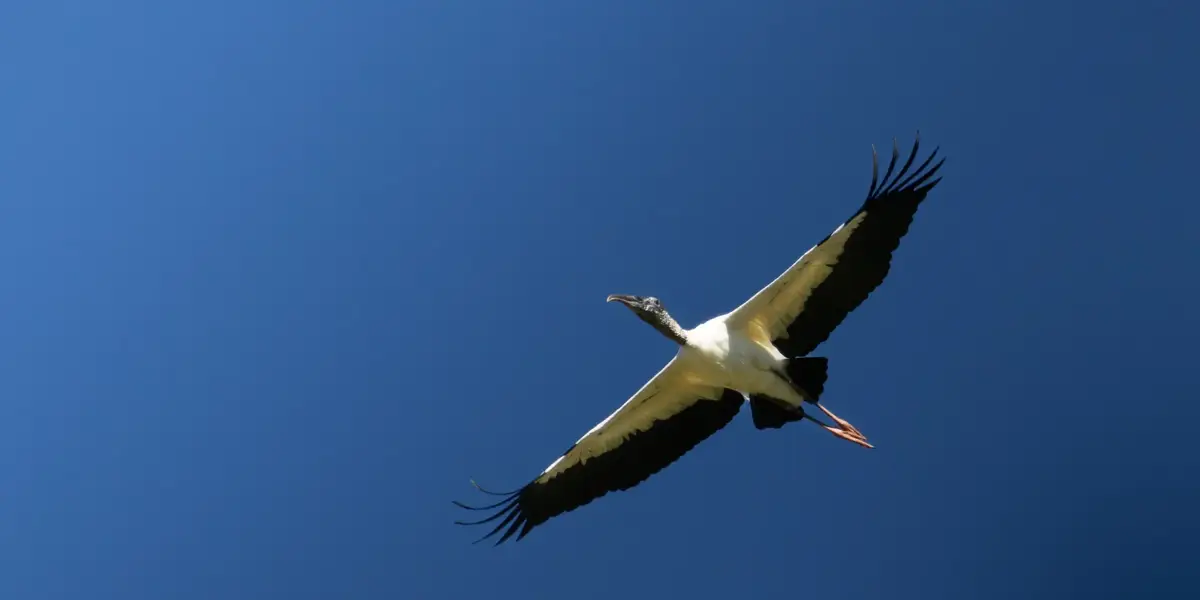
Wood Stork
Mycteria americana - Xexéu
Yellow-rumped Cacique
Cacicus cela - Quero-quero
Southern Lapwing
Vanellus chilensis - Chororó-do-pantanal
Mato Grosso Antbird
Cercomacra melanaria - Carretão-do-oeste
Yellow-breasted Blackbird
Agelasticus cyanopus - Canário-do-campo
Wedge-tailed Grass-Finch
Emberizoides herbicola - Colhereiro
Roseate Spoonbill
Platalea ajaja - Frango-d'água-azul
Purple Gallinule
Porphyrio martinica - Socó-boi
Rufescent Tiger-Heron
Tigrisoma lineatum - Garça-moura
Cocoi Heron
Ardea cocoi - Garça-branca-grande
Great Egret
Ardea alba - Águia-de-penacho (gavião-de-penacho)
Ornate Hawk-Eagle
Spizaetus ornatus - Gavião-caboclo
Savanna Hawk
Heterospizias meridionalis - Gavião-do-banhado
Long-winged Harrier
Circus buffoni - Marreca-cabocla
Black-bellied Whistling-Duck
Dendrocygna autumnalis - Jaçanã
Wattled Jacana
Jacana jacana - Graveteiro
Greater Thornbird
Phacellodomus ruber - Pica-pau-amarelo
Cream-colored Woodpecker
Celeus flavus - Maracanã
Blue-winged Macaw
Primolius maracana - Maracanã-de-colar
Yellow-collared Macaw
Primolius auricollis - Marreca-ananaí
Brazilian Teal
Amazonetta brasiliensis - Martim-pescador-grande
Ringed Kingfisher
Megaceryle torquata - Periquito-de-cabeça-preta
Nanday Parakeet
Aratinga nenday - Pica-pau-branco
White Woodpecker
Melanerpes candidus - Bico-chato-de-orelha-preta
Yellow-olive Flatbill
Tolmomyias sulphurescens - Trinca-ferro-gongá
Bluish-gray Saltator
Saltator coerulescens - Tuiuiú
Jabiru
Jabiru mycteria
Pantanal birdwatching: frequently asked questions
When is the best time for birdwatching in the Pantanal?
What is the difference between the Southern Pantanal and the Transpantaneira in the north?
Will I see a jaguar on this tour?
How many bird species can I expect to record?
Will I see Hyacinth Macaws?
How do I get to the Southern Pantanal?
Do you run Pantanal tours from Campo Grande?
Is the tour private, or will I share it with another group?
Do I need a guide for birdwatching in the Pantanal?
How much does a Pantanal birdwatching tour cost?
Can I combine the Pantanal with Bonito and the Chaco?
Records and references for the region
To research the birdlife of Mato Grosso do Sul before you travel:
- eBird — Mato Grosso do Sul
Checklists, hotspots and month-by-month bar charts for the state.
- WikiAves — Brazilian bird records
Photographs, sounds and distribution documented by Brazilian birders.
Related guides and tours
Birdwatching in the Pantanal: A Complete Guide
Top Birds of the Pantanal: 15 Species You Will Want to See
Hyacinth Macaw Tours: Where and How to See the World's Largest Macaw
Best Time to Visit Brazil for Birdwatching: A Month-by-Month Guide

How to Get to Bonito & the Pantanal
The Ultimate Brazil Birdwatching Itinerary: Pantanal, Bonito & Cerrado


Ready to see these birds?
Tell us your dates, group size and the species you most want to see. We reply with availability, a suggested itinerary and pricing.
Request a quote