
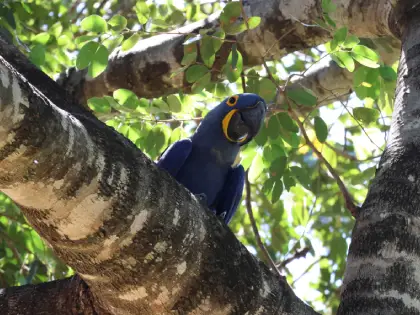
It's hard to prepare someone for the moment a crosses the sky for the first time. The wingspan, the colour, the sound — everything is striking. After hundreds of outings guiding visitors to them, I can say: the reaction is always the same.
The world's largest macaw
Reaching up to 1 metre in length with brilliant cobalt-blue plumage, the (Anodorhynchus hyacinthinus) is the largest macaw on the planet. Listed as "Vulnerable" by the IUCN, the wild population is estimated between 4,300 and 6,500 individuals — and the vast majority are found in the Brazilian Pantanal.
Where to find them
The Pantanal in Mato Grosso do Sul holds the largest populations. The birds can be seen feeding on acuri and bocaiúva palm nuts, their primary food sources. The Transpantaneira region and areas accessed from Bonito are strategic observation points. See our Southern Pantanal birdwatching tours.
At dusk, flocks of Hyacinth Macaws fly towards communal roosts — one of the most spectacular birdwatching sights in Brazil.
Behaviour & ecology
Hyacinth Macaws are monogamous, mating for life. They nest in hollows of dead trees, particularly manduvi trees, and typically lay 2 eggs per clutch, though usually only one chick survives.
Their powerful, hoarse call carries over great distances, making them easy to locate in the field. They are social birds that feed, fly and rest in groups.
Conservation & responsible tourism
Birdwatching tourism plays an important role in conservation. Tourist visits add economic value to habitat preservation, encouraging rural landowners to protect natural areas.
Bird Bonito follows strict observation protocols: respectful distance, no playback near nests, and contributions to local monitoring projects.
Want to see the in the field? Request a personalised quote.