
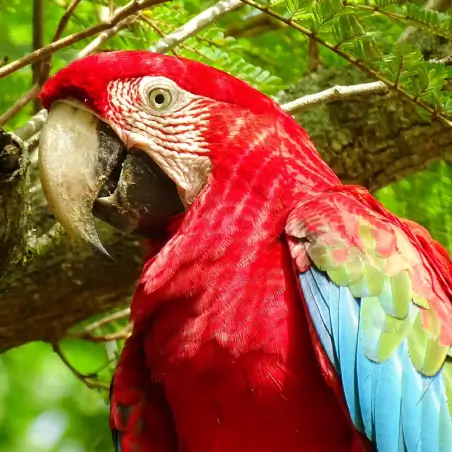
Few places in Brazil show off a bird as theatrically as Buraco das Araras. A giant red sandstone sinkhole near Bonito, it is home to a resident population of Red-and-green Macaws that nest on its cliff walls and circle over the chasm all day. This guide explains what the sinkhole is, the best time to visit, which other birds to look for, how to photograph the macaws and how to fit it into a birding trip.
What is Buraco das Araras?
Buraco das Araras ("Macaw Hole") is a collapsed sinkhole, or doline, in the municipality of Jardim, Mato Grosso do Sul, about an hour's drive from Bonito. It is more than 100 metres deep and about 500 metres across, with vertical walls of red sandstone and a small lake at the bottom where caimans live. Once degraded, the site was restored by its owners and is now protected as a private natural heritage reserve (RPPN).
Visits follow a short, easy trail around the rim to two viewing platforms, accompanied by a local guide. You do not descend into the sinkhole: the view is from above, looking down on macaws flying below you — one of the reasons the experience is so striking.
Which macaws live at Buraco das Araras?
The stars are the Red-and-green Macaws (Ara chloropterus), large red macaws with green and blue wings and a bare white face lined with fine red feathers. Pairs nest in cavities on the sandstone walls and stay together all year; the sinkhole echoes with their harsh calls as they leave and return.
Note that this is not the Hyacinth Macaw. The all-blue Hyacinth Macaw is a bird of the Pantanal palm groves; see our Hyacinth Macaw guide for where to find it. Blue-and-yellow Macaws (Ara ararauna) also occur in the Bonito region and are occasionally seen around the sinkhole.
When is the best time to visit?
Buraco das Araras is open all year, and the macaws are resident. Late morning is the classic time: the sun is high enough to light the cliff walls, and the macaws are active, flying in and out of the nest cavities. Early morning has softer light but often leaves the walls in shadow. During the second half of the year, pairs can be watched at their nest cavities, which makes for memorable behaviour and photographs.
The dry months (April to September) bring clearer skies; the rainy season (October to March) brings greener vegetation and dramatic clouds over the red walls.
Which other birds can you see there?
The rim of the sinkhole and the surrounding Cerrado add a good supporting cast. Vultures soar and roost on the walls; Toco Toucans (Ramphastos toco) visit the trees along the trail; parakeets, flycatchers and tanagers move through the vegetation; and raptors use the thermals over the chasm. The surrounding grasslands are good for Red-legged Seriemas and Red-winged Tinamous. A careful look at the lake below often reveals a caiman or two.
How do you photograph the macaws?
- Lens: a 100–400 mm zoom is ideal; birds fly both close to the platforms and far across the sinkhole.
- Shutter speed: 1/2000 s or faster for flight shots against the red walls.
- Exposure: the bright red plumage clips easily in strong sun; underexpose slightly and check your histogram.
- Composition: the best images often show a macaw from above, with the sandstone wall as background — a perspective you rarely get elsewhere.
- Patience: pairs follow a rhythm of departures and returns; wait at one platform rather than rushing between them.
More advice is in our wildlife photography guide.
How do you fit Buraco das Araras into a trip?
The visit takes about an hour and a half, so it combines well with other sites in Jardim. A classic Bonito birding day starts at dawn in the gallery forests or at Estância Mimosa, moves to Buraco das Araras in late morning for the macaws, and pairs it with the Recanto Ecológico Rio da Prata, whose riverside trail and bird hide reward early arrivals. Our guide to birdwatching in Bonito and the 7-day birding itinerary show how it fits.
Like all attractions in the region, Buraco das Araras is visited with a booking made in advance through a local agency. Bird Bonito includes it in the Bonito birdwatching tours.
Frequently asked questions
Are the macaws always there?
The Red-and-green Macaws are resident and present all year. Numbers in view vary through the day, so allow time at the platforms.
Is the trail difficult?
No. It is short and mostly flat, suitable for most visitors, including families.
Can I visit without a guide?
Visits are made with a local guide on a booked schedule. A birding guide adds the surrounding species and helps you time the macaw activity.
How far is it from Bonito?
About an hour by road, in the neighbouring municipality of Jardim, close to Rio da Prata.
See the macaws of Buraco das Araras with a biologist guide on our birdwatching tours in Bonito, or request a personalised quote.