
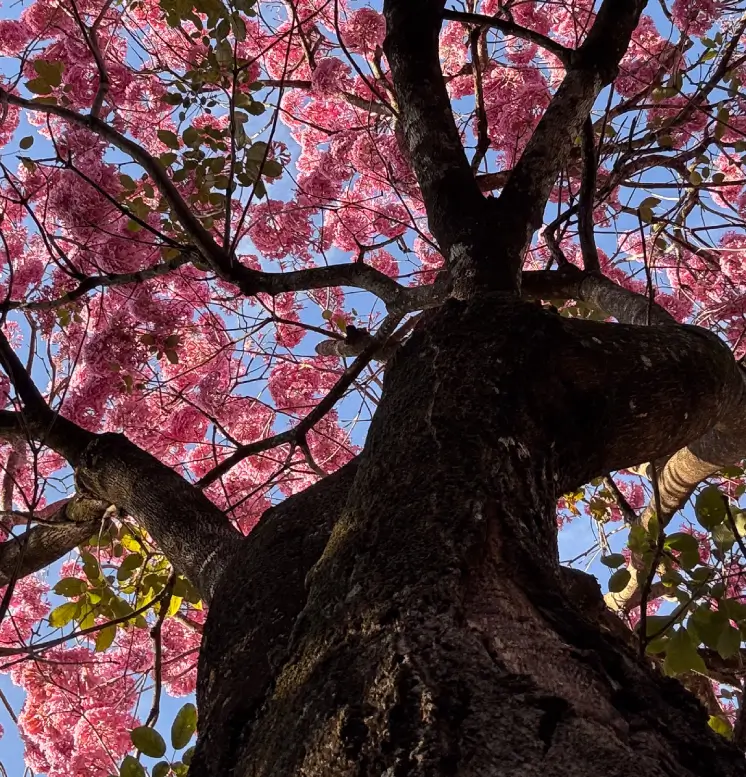
Chaco Birding in Brazil: Porto Murtinho Expeditions for Chaco Specialities
Chaco Birding in Brazil (Porto Murtinho)
Private 1–3 day expeditions into the only stretch of Chaco within Brazilian territory, at Porto Murtinho on the banks of the Paraguay River, led by biologist and guide Lucas Yanai.
In the far southwest of Mato Grosso do Sul, in Porto Murtinho, Brazil meets the Chaco — a biome still little explored within the country, yet strategically rich for birdwatching. On the banks of the Paraguay River, a natural corridor linking different regions of South America, the area hosts specialised species rarely recorded in other Brazilian destinations.
With vegetation adapted to climatic extremes, low forests and dry formations, the Chaco offers a landscape distinct from the Cerrado and the Pantanal. Its border location and proximity to continental migratory routes further enhance its potential for unique sightings throughout the year.
Seasonality directly influences access, environmental dynamics and species presence. Careful planning with a specialised guide is essential to select the most suitable period and maximise observation opportunities. The Brazilian Chaco is more than an itinerary extension — it is a biogeographical frontier where every field outing holds real discovery potential.
Headline species
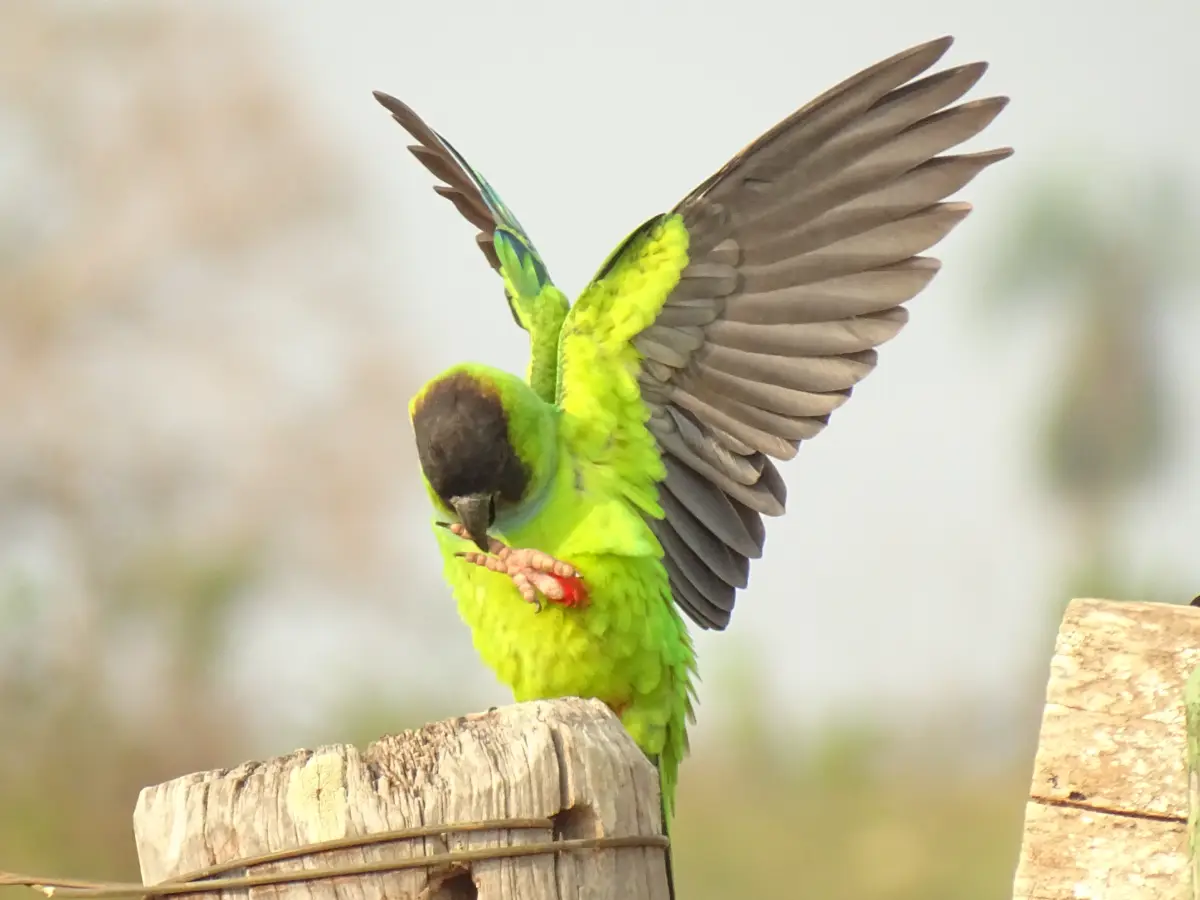
Nanday Parakeet
Aratinga nenday
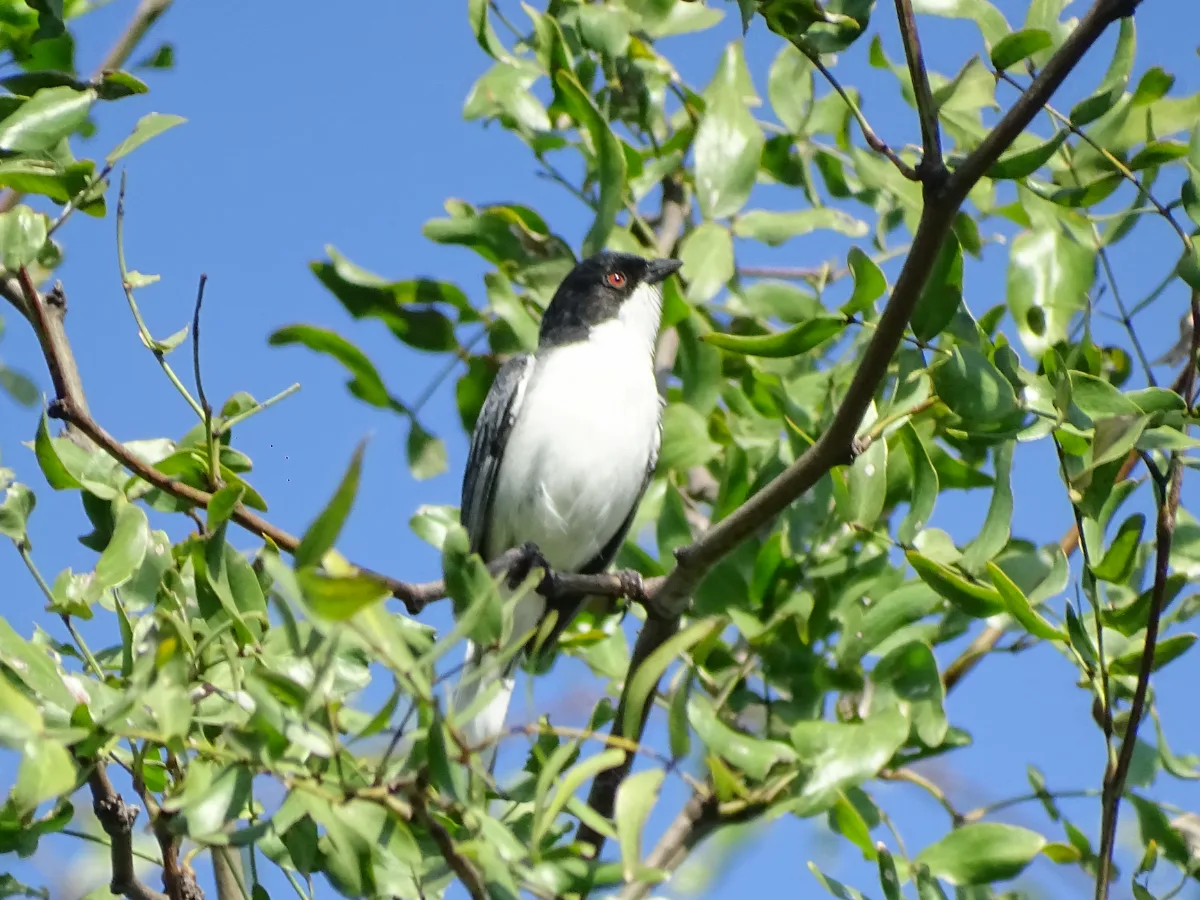
Black-capped Warbling Finch
Microspingus melanoleucus
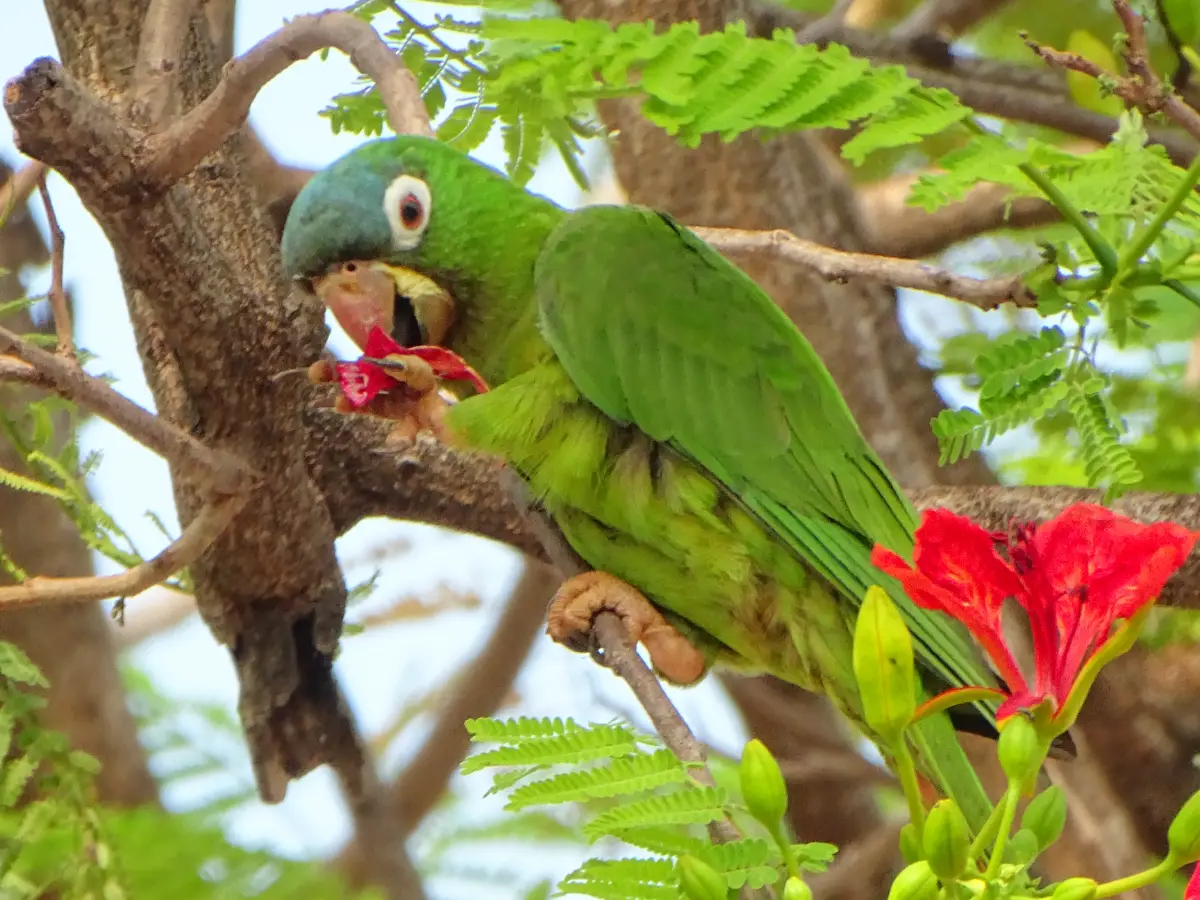
Blue-crowned Parakeet
Thectocercus acuticaudatus
Chaco birding tour at a glance
- Region
- Brazilian Chaco, Porto Murtinho, Mato Grosso do Sul
- Habitats
- Dry formations, low forest and the banks of the Paraguay River
- Duration
- 1 to 3 days
- Best season
- Dry season, July to October
- Format
- Private and tailor-made — for birders after specific Chaco species
- Guide
- Lucas Yanai, biologist, Cadastur-certified, 18+ years in the field
- Languages
- English, Portuguese and Spanish
- Level
- Advanced trail — strong heat and dry terrain
Why the Brazilian Chaco is a biogeographic frontier
In the far southwest of Mato Grosso do Sul, at Porto Murtinho, Brazil meets the Chaco — a biome that covers large areas of Paraguay, Bolivia and Argentina but is confined, within Brazil, to this narrow strip. For birders that means something very concrete: there are species here that are barely recorded anywhere else in the country.
The vegetation is adapted to extremes: low forest, dry formations and soils that go from waterlogged to cracked over the course of a year. The landscape is visibly different from the Cerrado and the Pantanal, and the birdlife follows that difference — whole families behave differently here.
The banks of the Paraguay River act as a natural corridor, linking distant regions of South America and bringing, along with continental migratory routes, records that fall outside the expected. That is why the Chaco rewards birders who already know the Pantanal and want to add genuinely new species to the list.
Seasonality weighs heavily: access, environmental dynamics and species presence all shift sharply through the year. Planning with a specialised guide is not a convenience here — it is what determines the outcome of the expedition.
Best time for birdwatching in the Chaco
The Chaco is the most seasonal of our three destinations, and the recommended window is narrower.
Dry season, July to October — the recommended window
This is when access is reliable and bird activity is most predictable. July and August bring cool nights and dry days; September and October get considerably hotter, which means earlier starts and a long midday break.
Wet season, November to March — limited access
Rain transforms the terrain and access routes can become impassable. This is not the season we recommend for a first visit to the Chaco; if your dates fall here, we will talk through what is realistic before you commit.
Brazilian Chaco specialities
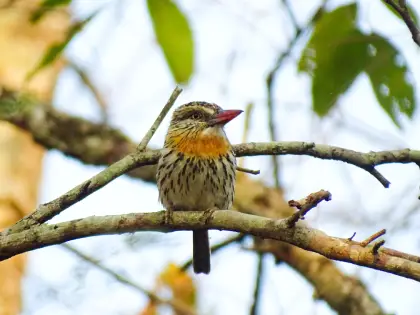
Chaco Puffbird
Nystalus striatipectus
One of the most representative birds of the biome — discreet and patient, often perched motionless on an exposed branch.
Black-capped Warbling Finch
Microspingus melanoleucus
A Chaco speciality and one of the expedition's target species, tied to the dry formations and low vegetation of the region.
Nanday Parakeet
Aratinga nenday
A parakeet species characteristic of the transition zone between the Brazilian Chaco and the Pantanal.
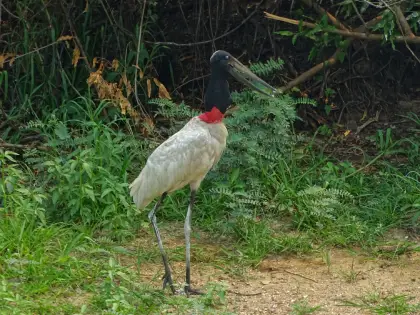
Jabiru
Jabiru mycteria
The great stork of the Pantanal also reaches the Chaco wetlands along the Paraguay River — a reminder of how closely the two biomes meet here.
What is included
- Cadastur-certified biologist guide (Lucas Yanai) throughout the expedition, in English, Portuguese or Spanish.
- Itinerary planning around your dates, pace, experience level and target species list.
- Field identification support and a list of species recorded by the end of the tour.
- Adventure insurance, included in all tours.
- Free cancellation up to 30 days before the tour date, and free rescheduling in case of adverse weather.
- Airport transfer and transport logistics arranged, once you share your flight details.
Practical information for reaching the Chaco
- Campo Grande (CGR) is the reference international airport, with the most connections; the expedition departs from there or from Bonito.
- Porto Murtinho sits in the far southwest of the state, on the banks of the Paraguay River. It is the most remote of the three tours and involves more travel time.
- Citizens of the EU, USA, UK, Canada, Australia and Japan do not need a visa for stays of up to 90 days in Brazil.
- Come prepared for strong heat and direct sun: plenty of water, sunscreen, a hat, light long sleeves in neutral colours and closed footwear for dry terrain.
Species you may encounter on this Chaco birding expedition
- Águia-cinzenta
Chaco Eagle
Buteogallus coronatus - Arapaçu-grande
Planalto Woodcreeper
Dendrocolaptes platyrostris - Periquito-rei
Peach-fronted Parakeet
Eupsittula aurea - Batuqueiro-chaquenho
Many-colored Chaco Finch
Saltatricula multicolor - Biguá
Neotropic Cormorant
Nannopterum brasilianum - Calhandra-de-três-rabos
White-banded Mockingbird
Mimus triurus - Soldadinho
Helmeted Manakin
Antilophia galeata - Quero-quero
Southern Lapwing
Vanellus chilensis - Chupim
Shiny Cowbird
Molothrus bonariensis - Carretão-do-oeste
Yellow-breasted Blackbird
Agelasticus cyanopus - Canário-do-campo
Wedge-tailed Grass-Finch
Emberizoides herbicola - Colhereiro
Roseate Spoonbill
Platalea ajaja - Frango-d'água-azul
Purple Gallinule
Porphyrio martinica - Garça-moura
Cocoi Heron
Ardea cocoi - Águia-de-penacho (gavião-de-penacho)
Ornate Hawk-Eagle
Spizaetus ornatus - Marreca-cabocla
Black-bellied Whistling-Duck
Dendrocygna autumnalis - Maracanã
Blue-winged Macaw
Primolius maracana - Maracanã-de-colar
Yellow-collared Macaw
Primolius auricollis - Asa-de-telha
Grayish Baywing
Agelaioides badius - Marreca-ananaí
Brazilian Teal
Amazonetta brasiliensis - Periquito-de-cabeça-preta
Nanday Parakeet
Aratinga nenday - Pica-pau-de-banda-branca
Lineated Woodpecker
Dryocopus lineatus - Pica-pau-de-barriga-preta
Black-bodied Woodpecker
Dryocopus schulzi - Pica-pau-de-testa-branca
White-fronted Woodpecker
Melanerpes cactorum - Pica-pau-de-barriga-preta
Cream-backed Woodpecker
Campephilus leucopogon - Rapazinho-do-chaco
Chaco Puffbird
Nystalus striatipectus - Saracura-três-potes
Gray-cowled Wood-Rail
Aramides cajaneus - Bico-chato-de-orelha-preta
Yellow-olive Flatbill
Tolmomyias sulphurescens - Trinca-ferro-gongá
Bluish-gray Saltator
Saltator coerulescens - Tuiuiú
Jabiru
Jabiru mycteria - Lavadeira-mascarada
Masked Water-Tyrant
Fluvicola nengeta
Chaco birding: frequently asked questions
What is the Brazilian Chaco, and why does it matter to birders?
When is the best time for birdwatching in the Chaco?
Is this tour suitable for beginners?
Which species are the main targets?
Can I combine the Chaco with the Pantanal and Bonito?
How much does a Chaco expedition cost?
Records and references for the region
To research the birdlife of Mato Grosso do Sul before you travel:
- eBird — Mato Grosso do Sul
Checklists, hotspots and month-by-month bar charts for the state.
- WikiAves — Brazilian bird records
Photographs, sounds and distribution documented by Brazilian birders.
Related guides and tours


Ready to see these birds?
Tell us your dates, group size and the species you most want to see. We reply with availability, a suggested itinerary and pricing.
Request a quote